


R.E.M. Album: «Murmur»
R.E.M. Album: «Murmur»
R.E.M. Album: «Murmur»
- Customers rating: (4.8 of 5)
- Title:Murmur
- Release date:1992-08-06
- Type:Audio CD
- Label:Emd Int'l
- UPC:077771315824
- 1 Radio Free Europeimg 3:10
- 2 Pilgrimageimg 4:31
- 3 Laughingimg 3:58
- 4 Talk About The Passionimg 3:21
- 5Moral Kiosk
- 6 Perfect Circleimg 4:14
- 7Catapult
- 8 Sitting Stillimg 3:31
- 99-9
- 10 Shaking Throughimg 4:31
- 11We Walk
- 12West Of The Fields
- 13 There She Goes Again (Live)2:48
- 149-9
- 15 Gardening At Nightimg 3:30
- 16Catapult
I was seriously all prepared to smack this album for being (a) strategically holiday-priced as overinflated, (b) stingy with the extras, and (c) suffering because of el lame-o artwork, blah blah blah. But one spin, and by "Catapult", I'm driving home from purchasing this, singing lyrics at the top of my lungs that were never there to begin with, deeply wishing I could shave 25 years off my life and encounter Berry Buck Mills Stipe again with a fresh set of ears, and even better, secretly negotiating with myself that the hefty price tag was completely worth it after three songs. It just is, and you know it.
What the heck is there to say about this album, except that for me and millions like me, this was "Meet The Beatles"? Or the Bible? Or the soundtrack to the best years of our lives? It would take a year to express why, how, what, and where - but let's get to the important stuff. This is a reissue done RIGHT. No loss of integrity or continuity by remaking the album's order or tacking on distracting extras you don't need or can get elsewhere. Decent, faithful art (okay, maybe the layout of the liner notes could have been less berszerk, but whatever man, play "Sitting Still" LOUD and get over it). A highly righteous live set from '83 that sounds (like all their early live sets did) like you're flying down the highway hands off the wheel headed somewhere, but you're not sure where, and could care less. And interestingly - a little melancholy feeling about where this band has ended up and how it got there, and why there will never be another moment like the first six seconds of "Perfect Circle", or the weird bridge in "Moral Kiosk", or the freaky instrumental moment before "We Walk" that sounds like no other band's music ever, or the elliptical chorus of "Shaking Through" that inspired a million stoned discussions, or the bridge to "9-9" when Michael's extended moan dissolves into an otherworldly growl, or Mike Mills' buried counterpoint in the chorus of "Pilgrimage", or the moment when the guitar just explodes in the end climax of "Laughing", or the feeling that "Talk About the Passion" can't end so soon, carried away on - of all things - the most stately string section ever assembled by a bunch of college kids from (ahem) Athens, Georgia, and their cadre of good ol' boy producers. Georgia??!?! Are you kidding?? Who knew? "And what is that guy singing? And why doesn't this sound like The Minutemen or Black Flag?" There just isn't an album like this, and won't be again, ever. You know it's true, and you already feel what this magnificent and essential moment means. "Murmur", remastered, and done RIGHT.
Well I can't believe that in the long review I put down there, I didn't really say exactly WHY "murmur" is the greatest album i've ever heard. Sooooo here, finally, in Lester Bangs "Metal Machine Music" fashion, are the reasons.
1. Throughout the entire album, vocalist Michael Stipe purposely makes the lyrics unintelligible so that the listener can more easily interpret the songs for his/herself. This may have also been a way to guarantee keeping this album in the underground so that it would never become popular with the uncool MTV crowd.
2. The talents of bassist Mike Mills should never be overlooked. Ever hear his basswork during the "Straight off the boat, where to go?" section of "Radio Free Europe", or the intro to "Laughing"? That song has THREE separate melodies in its three minutes of existence, and they're ALL great.
3. I read somewhere that the band was so ego-free that they had every instrument and the vocals balanced out in the mix so that no part would stand out. They wanted it to sound like a mush, which I think is really innovative, considering the overblown heavy metal that was popular at the time (this was 1983 remember).
4. A sad lament: Nobody makes their drums sound like the ones in the beginning of "Catapult" anymore.
Excellent drumming that actually sets a mood and isn't just mindless thumpity thump thump. Oh, and Bill Berry also wrote the piano line for "Perfect Circle", and for which we should all be eternally grateful.
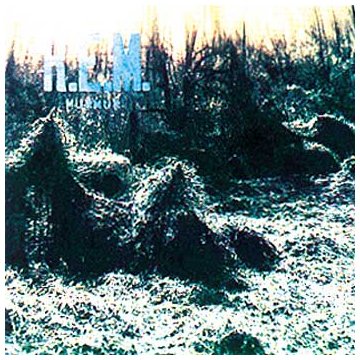
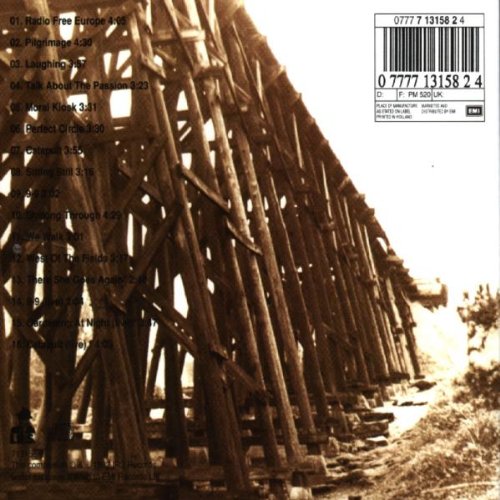
5. One of the best "anti-album cover" album covers: the dark kudzu tree field. The words "R.E.M. Murmur" are hardly noticeable, the song titles are arranged out of order (and in large purple smudgy type), the band members look as if they're having the worst day of their life, Michael looks funny with glasses, the title for "Moral Kiosk" is arranged vertically, and they even pick a typeface that's very difficult to read.
6. "Perfect Circle" is the greatest song ever written.
7. Like all classic albums, every time I listen to it I notice something new. Just yesterday, I noticed something that sounds a lot like a Gregorian chant or something during the refrain of "Pilgrimage". You have to really sit down and PAY ATTENTION to the little things, like the piano in "Shaking Through", or the thunder in "We Walk".
8. Trying to figure out what Michael Stipe is singing (especially during the chaotic bridge section in "9-9") is one of the best things about it. It makes you think, but not in a heavy pretensious manner. They could have equally called it "Mumble".
9. It was the very first "alternative" album. It sounded like absolutely nothing that was popular at the time, and it seemed to come from out of nowhere. I think Peter Buck once said something like "We wanted to make a record that had no influences so that nobody could say, 'Oh they sound like this band or that band'". And it came out at the right time. I don't know. It was just like, finally! After years of synth-heavy new wave one hit wonders and disco camp, there FINALLY was the band that meant as much to you as the Beatles and Stones meant to your parents. Ehh... Or something. That's how I felt, anyways. I mean if it wasn't R.E.M. then who was gonna save rock and roll? Okay okay the Replacements, but I mean BESIDES them. Huey Lewis and the News? Phil Collins? Motley Crue? 38 Special? See, the whole reason the words "alternative" and "indie-rock" were invented was because by 1984, MTV and "Thriller" had killed the face of mainstream music and it was albums like this that were considered worthwhile "alternatives" to the mainstream corporate rock sound. "Murmur" started all of that.
10. It's the greatest album ever made ever in the history of music since the beginning of time. But that's just me. You might hate it for some reason. Number two: Zaireeka!
I love soo much music, across many decades, and styles. But at the end of the day, Murmur is my most favorite album of my life. I can't quantify that statement, or substantiate it, it just plainly IS. I saw them several times; reckoning, fables, then later on green. every show exquisite. BUT nothing, not as single musical moment can match a quiet, personal headphone listening to Murmur. It resonates through my soul. And I am glad. It was Soooo out of synch with the plastic fantastic world of that time, so bold, thrust so deeply my pea brain.
Odd too. No women I have shared my life with at various times has appreciated this. No friend. I have known none that have appreciated what Murmur is. But I find my friends on reviews like this. Its nice to know others recognized what this was, and remains even today. I have ripped it several times my self, but going to buy this version as its a deeper re mastering.
<3 all fans of Murmur. For you just know.
Murmur is arguably the most important American record of the 1980s. It is seen by many as the birth of alternative rock. I can't quite agree with this assessment, but R.E.M.'s debut was literally music to the ears of music fans who couldn't quite relate to post-punk, new wave, and the MTV pop of the early 80s. Seemingly out of nowhere came a record with a rustic, acoustic feel, at a time when electric guitars were wiry and robotic, and synthesizers were on the verge of becoming a lead instrument. One might say that Murmur was to the early 80s was The Band's first LP was to the late 60s. And the fact that Murmur reached #36 on the Billboard Top 200 is a testament to the size of the market that R.E.M. was able to tap (not that that was their intention).
At the risk of making a potentially politically incorrect statement - a concern that I am sensitive to - I would say that R.E.M. were the founders of alternative rock in the same way that Columbus was the one who discovered America. While Murmur certainly sounded different than anything released in well over a decade, I still cannot help but give The Feelies' debut Crazy Rhythms the distinction of being the first alternative record. To me, Crazy Rhythms sounds different enough than what came before it, but enough like what came after it to merit this distinction. In other words, alternative rock was already there, but not many people knew about it. This is where R.E.M. comes in. As I said before, although Murmur had no apparent target audience and practically no commercial viability, it still reached the Top 40. Hence, the importance of Murmur - like that of Christopher Columbus - is immeasurable.
Murmur is a fascinating listen. It sounds like something unearthed from a spot where such a thing has no earthly business being. R.E.M. was influenced by artists from across the punk (The Velvet Underground, Patti Smith, Television) and pop (The Byrds, Big Star, The Soft Boys) spectrums, but managed to avoid sounding too much like any of them. This is a case of so many influences perfecting the sound. Like the best albums by the bands they loved, Murmur marks a point when music starts to sound differently. Perhaps the most obvious case of this is that after this album, lyrics could be not only be cryptic, but the vocals themselves unintelligible. The songs on Murmur - like the songs on Crazy Rhythms - do not seem to be about anything. "Perfect Circle", for example, is a fine case of how R.E.M.'s lyrics are more significant in terms of how they are said rather than what the actual words are (eg, "Standing too soon/Shoulders high in the room"). And while R.E.M. was a minimalist band at heart, producers Mitch Easter and Don Dixon succeeded in adorning the songs without swallowing them whole, such as in the waltz-like feel of "We Walk".
The disparate styles and sounds that merge to create the mural that Murmur is reflects the disparate backgrounds of the the band's members. Stipe was born in Decatur, GA, but formed his first band while in high school in St. Louis. Meanwhile, Peter Buck was born in northern California, Mike Mills in southern California, and Bill Berry in Deluth, Minnesota. Yet somehow, they were all able to come together at a party in Athens, GA, and henceforth be forever shrouded in the mythology of the American South. And of course, the irony is never lost on critics that the band's name refers to the state of sleep in which dreaming occurs, and thus their music and lyrics would forever be compared to the opaque, symbolic, non-linear images of dreamland.
Musically, Murmur delivers on the promise of the Chronic Town EP, with many of their trademarks firmly in place on the first single, "Radio Free Europe". Michael Stipe's voice isn't quite a drawl, but it has a nasally twang about it that gives it its edge. The arpeggios are invincibly crisp on "Talk About the Passion", and equally slinky on the rocking "Catapult" and "Sitting Still". On "9-9", the guitar richochets in between verses of Velvet Underground-like narration. And the rhythm section is nothing to sneeze at, either. Witness the thumping bass lines on "Laughing", and the footstomping beats of "Pilgrimage" and "Moral Kiosk". Then there is "Shaking Through", which is just beautiful, and "West of the Fields", a forceful closer to an almost flawless record.
R.E.M.'s debut LP was enough to convince skeptics and believers alike that there was probably nothing that the band couldn't do. Within five years, Rolling Stone would deem them "America's Best Rock 'n Roll Band", and few who were in the know would dispute the claim. Five years after that, R.E.M. would be America's biggest rock 'n roll band. Whether this was poetic justice or a travesty depends on your point of view. Either way, the band would always have its first half-dozen or so records to justify their worshipping audience and critical raves. With Murmur, they hit the ground running, and have kept moving, albeit a bit more slowly, for over 20 years since.
This LP is a sanctified relic. The songs breathe life, poignantly document what it felt like to be a young person toward the end of the 20th century. The music was kind and gentle, it suggested joy, it implied mystery, it ignited passion.
As a sophomore in high school, I bought this album when it was released in 1983. IRS originally distributed it with a [price] list price, and I purchased it on a lark. After spending a week with this sublime riddle of an album, I worked backwards and purchased "Chronic Town" (the 5 song EP the band had release in 1982). With "Murmur" and "Chronic Town" under my arm, I moved into a different future. I thought new thoughts, I met new people, I dreamed new dreams, and I had new destinations.
The indecipherable lyrics and murky cover art of "Murmur" only perpetuated the elusive beauty of the music. Everything implied, nothing handed over. Sun shining through a canopy of branches, never full exposure.
RADIO FREE EUROPE: My least favorite song on the album. The song that plays while people are finding their seats. PILGRIMAGE: Here is where the journey begins. The REM aesthetic was all about discovery, passion, mystery. If it's good enough for Chaucer, it's good enough for me. "Take your time...pilgrimage has gained momentum!" Are we looking for the two-headed cow? I'm in... LAUGHING: A gentle song about who knows what. Lighted, laughing at you, with you. Who knows. TALK ABOUT THE PASSION: A simple song, statement of purpose. Let's talk about the passion. Reagan may be in office, but let's explore the unspoken, our hearts and loins so full of passion we must speak. "Not everyone can carry the weight of the world". MORAL KIOSK: It wasn't conservativism, but REM implied a morality. A spirit of community. "So much more attractive inside the moral kiosk". Higher, twilight, but instead... PERFECT CIRCLE: "A perfect circle of acquaintances and friends. Drink another, coin a phrase". A song about friends, and spending time randomly with drunken exuberance and subtle commitment. "Take your dress off and stay real close". CATAPULT: REM's world (from 1982-1984) was very childlike. It evoked innocence, it remembered the youthful skin we were in the process of shedding. Did we miss anything? SITTING STILL: The REM call to action. One of the highlights of REM's early shows. Warned us all to not "waste your time sitting still". I can hear you. Can you hear me? 9-9: Didn't like this song for the longest time. Then it grew on me. And now I've forgotten it. SHAKING THROUGH: Yellow like a geisha doll, wandering, shaking through, pointless discovery. This is a sparkling gem. Could it be that one small boy doesn't... WE WALK: A lilting little ditty about walking, with friend, up the stairs & to the home, through the forest. A favorite for most. WEST OF THE FIELDS: Album closes with a darker feel than at any previous point in the album. The most haunting & memorable bridge on the album. Don't have any frigging idea what this song is about, but sounds like termites are in the foundation, the wells dried up, the truck has been repossessed, sissy ran off with a travelling salesman, and all that's left is whatever the hell lies west of the fields.
I have no idea what this album would sound like to the uninitiated or someone who already knows REM post-1985, but I would like to think that some 17 year old kid could still tap into the magic this music implied, promised & produced back in the day. Oh, and "Reckoning" (which is the electric brother of this album) is every bit as stunning. However, the band's music produced diminishing returns from that point forward. I have enjoyed occassional songs from occassional REM albums since this period, but am usually saddened that the golden sounds of my youth were supplanted by the diamond-studded cash cow.