


Philip Glass Album: «Philip Glass: Symphony No. 2»
Philip Glass Album: «Philip Glass: Symphony No. 2»
Philip Glass Album: «Philip Glass: Symphony No. 2»
- Customers rating: (4.2 of 5)
- Title:Philip Glass: Symphony No. 2
- Release date:1998-04-21
- Type:Audio CD
- Label:Nonesuch
- UPC:075597949629
- Average (4.2 of 5)(14 votes)
- .9 votes
- .1 vote
- .3 votes
- .0 votes
- .1 vote
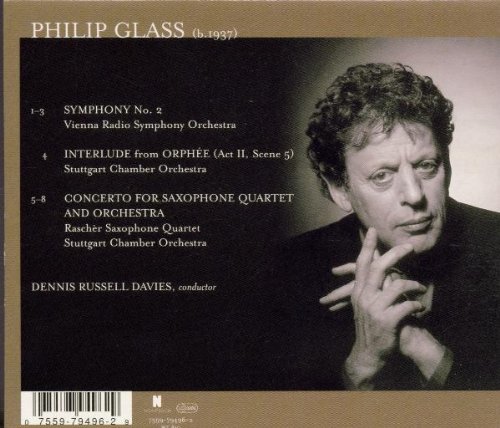
- 1Symphony No.2: Movement I
- 2Symphony No.2: Movement II
- 3Symphony No.2: Movement III
- 4Interlude From Orphee (Act II, Scene 5)
- 5Concerto For Saxophone Quartet And Orchestra: Movement I
- 6Concerto For Saxophone Quartet And Orchestra: Movement II
- 7Concerto For Saxophone Quartet And Orchestra: Movement III
- 8Concerto For Saxophone Quartet And Orchestra: Movement IV
Symphony No. 2 is one of those works that you might not like on the first hearing; there is a dissonant atonal quality that persists throughout the work. However, by the second or third playing, you will be completely mesmerized by this music. It is easily one of his greatest works. The first and second movements are absolutely stunning! The third movement has much more complex rhythms but is equally beautiful in its own way.
The Saxophone Concerto is a lighthearted work, and quite different in mood from the symphony. These two works are best listened to separately, otherwise you may not appreciate the lighter tone of this concerto. This music is reminiscent of that excellent CD of Stravinsky's lighter music called "Shadow Dances". If you like Shadow Dances, you will like this concerto.
The only flaw on this otherwise perfect album is to be found on the album's liner notes: the short interlude sandwiched in the middle between the symphony and the concerto is too short! The album notes say it is 6'30" long, however is only 2'30".
Philip Glass has written all of his five symphonies in the nineties, and they are beautiful symphonic masterpieces (his latest was premiered in summer 1999). His Symphony No.2 (1994) has a wonderful moving, melancholic middle movement and an upbeat finale. But I think the Saxophone Quartet Concerto(1995) is even better; its first movement sounds rather gothic (very Edgar Allen Poe), the second is very jazzy. The third is one of the most tranquil slow movements I've ever heard (a rainy night in Manhattan?). The last is very fast, light and upbeat. Phil Glass beautifully blended elements from (french? - I think there is some Satie, Ravel and Poulenc in it) classical music, jazz and rock in that piece, but its pure Glass. It's great.
This new recording is incredible! Not only is the symphony great, but I find myself listening more to the Concerto for Saxophone Quartet. The piece has four movements, each equally impressive. The Sax. Concerto is one of the pieces that truly shows off Glass' skill as a composer.
Philip Glass's Symphony No. 2, in three substantial movements, represents his music at its most mellifluous, his second-generation brand of minimalism. Written in 1993, it uses polytonality as a basic element, to a degree taking the place of contrasts traditional in symphonic form. The first movement, longest of the three, is lush and lyrical, with melodies turning back on themselves, while the central slow movement jogs along similarly with minimalist "till-ready" rhythms. The finale is bolder and brassier, with piano bringing echoes of "Petrushka." The Interlude from Orphee is vintage Glass, while the more compact Saxophone Quartet Concerto brings the liveliest music and Spanish-American flavors in the finale varying Glass's persistent moderato writing. Excellent performances and well-balanced recording.
There is an unspeakable fear in this music - there is a vision of humanity which I have heard nowhere else. On the first few listens, this piece may sound strangely dissonant. Persist - I've had aural orgasms to this one. One of my favorite Glass pieces.