


Peter Green Album: «The End Of The Game»
Peter Green Album: «The End Of The Game»
Peter Green Album: «The End Of The Game»
- Customers rating: (3.9 of 5)
- Title:The End Of The Game
- Release date:1996-05-13
- Type:Audio CD
- Label:Warner Bros UK
- UPC:075992675826
- Average (3.9 of 5)(25 votes)
- .9 votes
- .7 votes
- .6 votes
- .3 votes
- .0 votes
- 1 Bottoms Upimg 9:07
- 2Timeless Time
- 3Descending Scale
- 4 Burnt Footimg 5:10
- 5Hidden Depth
- 6The End Of The Game
...there might be a planet where radio stations play great music. Until we find that planet, you'll have to check out CD's and other media.
"The End Of The Game" is Peter Green's foray into something that is truly genre bending. Is it Jazz? Rock? Blues? Is it Ambient music? Or is it variations on Folk melodies? It's a bit of all of the above, and the terms "mind expanding", or "stunning" come to mind upon listening.
The expansive musical exploration suggests why Peter Green and his former bandmates in Fleetwood Mac evenutally parted company. Fleetwood Mac wanted to play more traditional and familiar blues variations and rock tunes, while Green seems as if he wanted to fuse the improvisations of Jazz/rock musicians like Frank Zappa and John McLaughlin, with the blues of early John Mayall and Jimi Hendrix at his peak.
The music here is wordless, and it is as compelling as anything released by the likes of John Coltrane or Miles Davis. Because it is not easily classified as to musical type (rock, blues, or jazz are all equally applicable), it is not "radio friendly", and probably doesn't fit into any pop or other contemporary radio formula--so don't expect to hear it on most stations.
"The End Of the Game" is probably a bit too "far out" for many listeners' tastes, like most of the output by the aforementioned jazz legends. Like a lot of jazz and ambient music, this is not a collection of catchy melodies and clever hooks. Unlike a lot of avant-garde music, though, this stays based in blues chord and rhythmic strucutes and never drifts into the "wierdness for the sake of wierdness" realm that ultimately sinks most expermimental music.
Of Green's subsequent CD's, only "In The Skies" even comes close to this. While I liked the songs, rhythms, and melodies on "In The Skies", it left me with none of the sense of exploration and adventure that this CD does.
This CD holds up well to many repeat listenings, and all but demands to be digitally remastered.
I normally avoid instumental guitar albums like the plague, but being a Peter Green die-hard I had to pick this up back in 1970. I did'nt really care for it then but I love it now! No other guitarist had the burning tone of Peter Green. Some were faster, some more skilled technically, but no one was as expressive with the six strings as Peter Green. This CD is kinda short. You'll wade through a few boring moments in the jamming, but the rewards are far greater than the downside. Five stars for a incindiery talent who never burnt out. Fans of The Mac, fans from Peter's recent and welcome return to form, and fans of red hot and blue guitar need this one.
As another reviewer pointed out, this album is really a jazz-rock fusion album, in keeping with Miles Davis's 1970-1975 work. That's my favorite Davis period, so I had no trouble at all connecting with this album when I bought it several years ago.
I think I prefer Green's editing to Teo Macero's, though. Rather than splicing jam sections together (cf. "Jack Johnson"), Green seems to have focused on the heart of each jam and given it a space of its own. I suspect that this would have been a double album had Macero been the producer.
I also prefer Green to John McLaughlin and Pete Cosey (Davis's guitarists)--and any other guitarist, for that matter--because of his sense of time, his touch, and his tone (Carlos Santana owes him millions). His extensive use of the wah-wah pedal makes this album very interesting for Green watchers.
However--and a big "however" this is--if you question the value of Davis's electric period or expect blues or blues-rock or rock or ballads from Peter Green, then you may want to keep your distance from "The End of the Game."
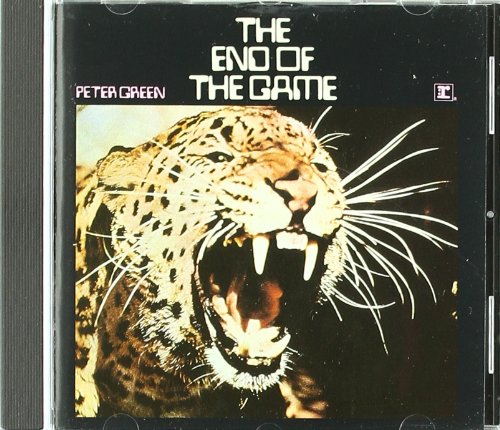
This has got to rate as the single best theme album of all time. An instrumental disc by the famous Peter Green, founder of Fleetwood Mac, it charts a day in the life of a jungle cat. Jazz rythms, percussion and wah-wah guitar elicit a true feeling of the joy of being a big cat, running through the jungle, chasing prey, contemplating your reflection in a still pool, preparing for sleep, and finally, achingly, being killed by a hunter. (Gunshot at end on original vinyl was editted out by some engineer for CD version; sadly)
This is my single favourite album of all time.
Be forewarned, if you're still somewhat new to Peter Green and your journey began with his incandescent blues (with John Mayall's Blues Breakers; with the original Fleetwood Mac; with his brief late-1970s/early-1980s return; in his career since 1995), that this isn't the Green God whose reputation as perhaps the finest, and certainly the most lyrical British blues guitarist (which is saying something considering Eric Clapton was his Blues Breakers predecessor and his peer, until his Fleetwood Mac departure and swelling mental problems) of the breed. Instead of solid songwriting and Green's customary lyricism, this is a set of almost entirely-meandering jams.
A jam album featuring Green wouldn't have been a terrible idea on paper; the last months of Green's Fleetwood Mac showed that aggregation becoming a capable jam outfit (just catch onto any live recording of "Rattlesnake Shake" or "The Green Manalishi" for the evidence, not to mention the extensions of "Black Magic Woman" they were wont to perform), and Green himself seemed to thrive in that environment as readily as he thrived playing his blues. But this isn't a Fleetwood Mac album; these musicians aren't Danny Kirwan, John McVie, and Mick Fleetwood; and, this Peter Green was a psychological mess. It's one thing to acknowledge that he was beginning to think above and beyond the blues box well before he finally did walk out of Fleetwood Mac, but it's something else again to take "The End of the Game" at face value.
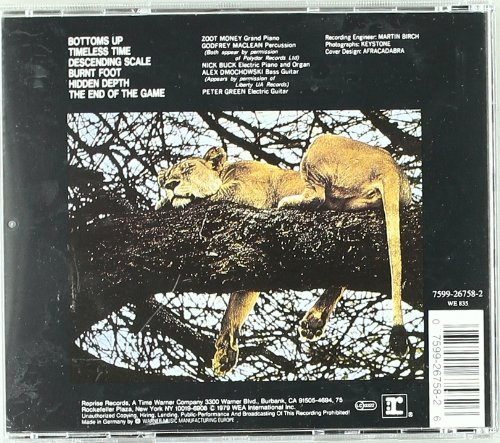
The lone exception is the set opener, "Bottoms Up." Here, Green and his cohorts (including his early mentor, Zoot Money) seem to keep each other within a somewhat defined anchorage, letting each other spread but not veer too wildly off the path. It's jarring to hear Green investing as much as he does in the wah-wah pedal; he'd been one of the most singular sounding guitarists on the planet until this, his tone, his economy, his phrasing, and his feeling the envy of many a bluesman black and white alike. But now he's smothering his formidable approach to the instrument in a Hendrixian wash that doesn't always suit him, even if he can still find the lyricism beneath it, something he seemed to know along the way by the manner in which he suddenly drops back and allows the remaining quartet (Money and Nick Buck, keyboards; occasional Frank Zappa cohort Alex Dmochowski, bass; Godfrey Maclean, drums) to jam without him for a spell, before he returns with another round of wah-wah bursts that sound like things Hendrix himself excised from potential finished "Electric Ladyland" takes but don't sound especially terrible, and his musical companions support him sympathetically and tastefully enough, all things considered. Above any other cut on this disturbing set, here is the cut on which the one thing Green seems to have intact is his flair for melodious improvisation and for shepherding a band, however haphazard, through an oddly embracing journey.
The remaining performances (said to have been edited down from a round of long in-studio jams) have a few moments of intrigue, a few other moments of atmospheric music, and a few too damn many moments of a leader in search of a sound and a band in search of its leader. It's not so much unlistenable as it is unsettling and unaffirmative, even if---as the recorded oeuvre of acid casualties goes---this isn't even close to the deconstructive dissembling of most of Syd Barrett's post-Pink Floyd work. The major problem is that Green isn't even sure whether he has something to say, other than how much it was time for a change. That one of the best composers, too, of the British blues movement of the mid-to-late 1960s is reduced to these struggling jams (this can't possibly be the same whole musical mind that once produced "The Super Natural," or "Albatross," or "Black Magic Woman," or "Man of the World," though the fourth of those examples chillingly telegraphs the spinout this album amplifies) testifies even more sadly to what was throttled as Green spun into despair and mental illness during and after this project.
It would take about a decade before he began to find things to say again, and even began returning to his blues roots without merely recycling his old music. Hark to "In the Skies" and "Little Dreamer," on each of which he begins again to sound like the Greeny everyone loved without sounding retro or stunted or meandering, even if he didn't quite sound as bold as before just yet and some of the R and B extractions with which he'd experiment on those albums didn't really suit him as well as his blues and introspective quiet rock did. Then, hark ahead further to his work with Splinter Group and his full-tilt return to the blues, ancient and modern. Today, "The End of the Game" is merely a disturbing (if occasionally fascinating) interlude, but in 1970 it must have sounded to only too many as if Peter Green was going to prove an irretrievably lost soul.