


Neil Young Album: «Are You Passionate?»

Neil Young Album: «Are You Passionate?»
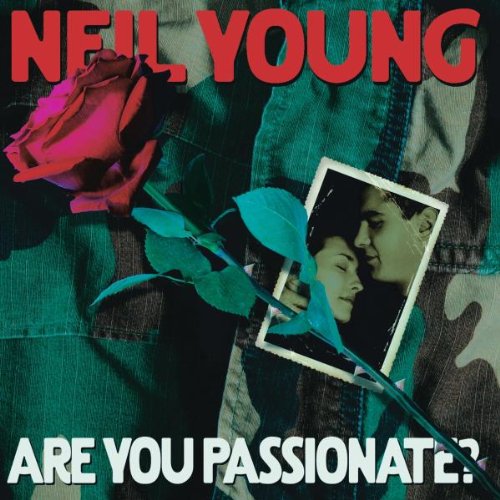
Neil Young Album: «Are You Passionate?»
- Customers rating: (3.6 of 5)
- Title:Are You Passionate?
- Release date:2002-04-09
- Type:Audio CD
- Label:Reprise Records
- UPC:093624811121
- 1You're My Girl
- 2Mr. Disappointment
- 3Differently
- 4Quit (Don't Say You Love Me)
- 5Let's Roll
- 6Are You Passionate?
- 7 Goin' Home Crazy Horse and Neil Youngimg 8:05
- 8When I Hold You in My Arms
- 9Be With You
- 10Two Old Friends
- 11She's a Healer
This album is ok, some of the songs are good, some aren't but what I really want to say is, will everyone please stop slagging Neil for writing "Let's Roll"? Admittedly it's not a very good song, but everyone who is calling it right-wing, jingoistic, and hypocritical (or anyone who is saying, haha, even lefty Neil Young supports this war)is just plain WRONG. People are completely taking the song out of context. It's about the passengers on Flight 93 fighting the [enermy], and it is a tribute to them and their courage. The song is not about America's current foreign policy. The song is not about America's strikes on Afghanistan or the War on Terrorism in general. So everyone stop trying to make [a] song mean something it doesn't. Thank you.
I was inspired to buy this CD after seeing Neil Young perform the title track on the Jay Leno show. Just the fact that he was backed up by Booker T and 3/4's of the MG's was enough for me! The song itself grabbed me with it's fifties beat and oddball NY lyrics. I loved it. I bought the CD the next day.
I don't care what anyone says, Neil Young is and always has been an original. Now in his fifties, he continues to refuse to conform and that's all right by me. This CD is yet another facet of this incredibly talented performer. I especially like, Mr. Disappointment, Quit (Don't Say You Love Me) and, of course Are You Passionate. The only track that I seem to skip is Let's Roll. It doesn't sit well with me for some reason. But that's not enough for me not to declare this a five star winner.
I respect any artist who can continue to perform into their 50's (and now 60's for some). It proves to me that we were right all along. The music I grew up listening to is solid, lasting and, in my humble opinion, the best ever. Neil, keep on rockin' and I'll keep on listenin'.
I am always mystified whenever a new Neil Young album is touted as being a "return to form." Has anyone else noticed that Neil Young does not take any consistent form, never has, and probably never will? I don't listen to Neil Young because I want to hear the same sound on every album. I listen to hear something that's fresh and expressive and speaks to the human condition-- he has very rarely disappointed me in that respect. So perhaps the fact that I'm not one of those fans that requires every helping of Neil to be come with a side order of Crazy Horse places me in a more tolerant disposition towards Are You Passionate? From the get-go. Be that as it may, this is certainly not a flawless album and actually took some time to grow on me as much as it has.
Are You Passionate? has often been described as a romantic album and, while many of the songs seem pretty clearly to have been written with Mrs. Young in mind, to say that 'Passionate' Is about romance and only romance is oversimplification if not misinterpretation and likely represents a complete misunderstanding of the title. Are You Passionate? is in fact, and in spite of the rhythm and blues styling that permeates nearly all of the tracks, one of Neil's most multi-faceted and complex albums. Much of this arises from the fact that a lot was going on in 2001, when these songs were written and recorded. And of course, there's always a lot going on in Neil's mind-- and as Neil himself says, "Strange things happen when worlds collide."
The first three songs flow into one and other almost seamlessly. You're My Girl has grown a lot on me, though I still don't think it's a great song. It's about Neil's daughter growing up and going to college and is really quite sweet. The tune is also a real toe-tapper in its own right, while the arrangement firmly establishes an R&B sound that permeates most of the album--it's polished unlike most Neil Young music, and shiny to the point that some listeners may require sunglasses, but this is in accordance with the style it seeks to evoke. In addition, the lyric contains some nice images-- the metaphor of the "forest floor" for the world and the "falling leaves of time", and references nature repeatedly, with mentions of the "sun and the water." It's not a huge deal, nor the focus of the song, but it's something extra that adds to the appeal for me.
Mr. Disappointment and Differently are two of the album's strongest tracks. Disappointment reels to listener into the album after a tentative start with the previous song. Its greatest strengths are Neil's quite intentionally gravelly delivery of the clever lyric and the soulful instrumental break before the last verse, while Neil's concept of personifying disappointment in the form of an adversary is one of the most imaginative things I've ever heard in a song. This was one of the first songs on the album really appealed to me. Differently is equally clever, not least of all in that it works dance steps ("turn it around, bring it back") into the lyric of the song. Differently is a song about the choices we all make every day and how, in spite of our desires to change some of them after the fact, we cannot and must live with our errors. All that can be done is to make amends to the best of one's ability. Sometimes this works better than others, and here Neil appeals directly to those he has hurt for forgiveness and a fresh start. Personally, I related to this very strongly as I imagine do many others--even the most trivial of mistakes can weight heavily on your mind at times.
Quit (Don't Say You Love Me) seems to come as the response of the second person in the relationship to Differently. As well as being a beautiful melody, with exquisite guitar from Neil, it is also an extremely heartfelt song, played out as a conversation between two lovers trying to cope with difficulties in their relationship. You can almost feel the pain in Neil's voice on the refrain: "Don't say you love me--that's what she said!") It could perhaps have been more appropriately titled "Don't Say You Love Me (Just Say you Want Me"), but then that would have spoiled the twist at the end, by which time, suffice it to say, you can almost picture the couple concerned beginning an impassioned act of physical intimacy while electric guitar and tender piano mingle before a rock-solid rhythm section. Ultimately, though, it's just a great mellow song for when you're worked up, to calm you down and remind you of what really matters in life. It also seems to be the outcome of the first four tracks and set up for the remainder of the album--Neil urging not only his lover but also listeners to "stick around" and see what he has in waiting for us, even after a forty-year plus career, and he hasn't stopped to this day.
He's never feared controversy, either and next is likely the most controversial song he has recorded in several decades: Let's Roll. This is an immediate response to the 9/11/2001 terrorist attacks on the United States of America. Most of it is concentrated on paying tribute to the everyday American people-turned-heroes who overpowered the hijackers of Flight 93 and, in so doing, prevented even more destruction and loss of life. Whether or not anyone actually said, "let's roll" we'll probably never know for sure, but that's irrelevant anyway-- it's the sentiment that matters. Whether or not the use of the phrase itself is an urban legend (and whether or not Todd Beamer called his wife, because really, there's no indication in the song that he's supposed to be the one singing the first verse--they could all be from the viewpoints of different passengers come to that, especially with the altered method of vocal delivery on the countermelody verse), that the passengers on Flight 93 attempted to overcome their hijackers and died in their effort to prevent further destruction and loss of life is not. I think that's worth remembering and honoring, especially because not even the people on the other three hijacked planes, who were placed in the exact same same life-or-death situation, possessed the emotional, moral, and physical courage to do what those on Flight 93 attempted.
"Let's roll", whether not it was the real dialogue, is, I feel, an appropriate phrase with which to express the spirit of this courage and determination. I believe the essence of the song is the spirit of those who would sacrifice their own lives to prevent bloodletting, destruction, and devastation on a wider scale. One has to think survival instinct pulled them both ways as, if they hadn't interfered with the hijackers, they would have stayed alive longer yet they would have been dead either way--at least as far as they knew, since there was apparently no certainty that anyone could take physical control of the plane if and when the hijackers had been removed and land it safely. But I digress.
Whether or not anyone actually said "let's roll" on Flight 93, I think it's a great metaphor to having the courage and determination to take physical action when there is no other reasonable option. It's an admirable show of support, respect, and thankfulness for people who have enough courage and moral strength to do what they feel is right regardless of any consequences on themselves. "You've got to turn on evil when it's coming after you" was Gandhi's philosophy, too.
Next up is the title track, located dead center as the sixth of eleven tracks on the album. This was one of the first I was drawn to on the album. A bluesy arranged brilliantly in waltz time, if you can imagine such thing, this is a natural follow-up to 'Let's Roll', beginning with a poignant lament of the struggle to survive "in a world that never stops turning on you, turning on me." This can be seen as a reference to catastrophic and tragic events such as 9/11. The song, as it continues, becomes increasingly obscure and difficult to interpret. I don't believe the narrator(s) of the countermelody sections is/are necessarily supposed to be the same person singing the verses, which suggest the narrator is an artist considering his craft: "Are you going to the top... "The love that never stops/coming to me/coming to you/coming to me." The middle sections then launch into what appear to be demonstrative bursts of the artistic inspiration. The separation is indicated to me by the double-tracking effect used to alter Young's voice from the unadorned delivery of the main verses. Overall, the song seems to me to be an image of the "real world" set against intrapersonal artistic angst, blending to form a tonally dark and psychologically complex whole.
As an aside, a possibility regarding the lyric of the soldier throwing the missiles that "might be the ones that kept you free" is that Young is singing purely from the soldier's perspective: that's what he'd hope (however vainly) the missiles would do, or he wouldn't throw them. "Fighting in the sky", to me, suggests air support or an air raid. "Dove into the darkness", with no indication of ever coming out of it again, suggests death--so the soldier is speaking as if from beyond the grave, not knowing for certain the earthly outcome of his actions. Yet he would not have committed them unless he believed they the potential to save lives and/or liberties.
Then it's on to the last half the album. This portion is bookended by the two truly epic tracks here. There's usually at least one massive, sprawling jam on any Neil Young album featuring an electric guitar, and here we have two. One is remarkable for its lyrics, the other for its instrumental experimentation. 'Goin' Home', the first of the two, is completely different than the rest of the album. It was required at a separate time with Crazy Horse, Young's longtime backup group, and it shows. Young and Pancho Sampedro's guitar parts are tantalizingly brief but searing. Ralph Molina hammers out a driving rhythm, reminiscent of Native American war drums. The lyrics themselves are some of the most interesting and poetic here, dealing with General Custer's last battle, Native American culture, and all sorts of other things. I won't even begin trying to scrutinize the various verses in the confines of this forum. Suffice it to say that, along with the awesomely powerful music, there is some truly great imagery here ("her clothes were changing--into sky and stars"), which, combined with the droning distorted guitars, creates a strangely entrancing aesthetic. The ending is equally ingenious, musically speaking: the intensity builds, builds, and builds, as the main riff is pounded out endlessly, overlaid with Neil's signature barbarian solos, just heightening, heightening, heightening in intensity. And then... it just stops. Abruptly. Just as if I were to end this review mid-sentence.
Several seconds later, we're on to 'When I Hold You in my Arms', in an almost seamless segue. Musically a throwback to '50 R&R ballads, it picks up where 'Quit' leaves off. It's a comforting, heartfelt number that's grown on me quite a bit. The lyrics are excellent and the whole message is encapsulated in the chorus line: " New buildings coming up. Old buildings coming down. New signs coming up; old signs coming down. We've got to hold on to something in this life." This song, while not one of the album's very best, epitomizes its core themes in a few short verses.
It is followed by the much more upbeat, yet lighter, 'Be With You', which is funky and a lot of fun. And definitely out of the ordinary for Neil. It's a warm message, rendered with good fun for all. How can one not break into a grin on hearing Neil's unmistakable tenor declare, "Girl, it shouldn't be too hard to live with you. It's really not complicated until I get the blues." It sounds like Neil is having the time of his life here, and the festive mood, shown here and on other potentially danceable tracks such as 'Differently', can quickly spread to the open-minded listener.
The final ballad, 'Two Old Friends', however, elevates the album to entirely different place. It is the beautiful and majestic tale of a preacher seeking Divine council. He laments a world filled with hate and sadly lacking "love and music in the air", sentiments to which I'm sure many of us can relate. The preacher, and Neil, and the audience, seek here to elevate themselves to a higher spiritual plain, to "see no evil, fear no evil, feel no evil." This is an album highlight and a beautiful and tranquil number I often like to hear after listening to 'Let's Roll.'
'She's a Healer', the positively brilliant album closer, I will not try to summarize in words. At nine minutes, it is the longest track on them album, and one of the best. You simply have to hear it. The most I can say is that it's like a rhythm and blues reinvention of 'Cowgirl in the Sand'--pretty much that good. It blends a really cool "soulful" guitar tone with Booker T's organ, a spirited piano, heavy bass courtesy of Donald "Duck" Dunn and a trumpet, all of which are layered upon a simple but addictive riff, used in trademark Neil Young fashion to build up what could be a simple 3-4 minute tune to genuinely epic proportions.
-- Pure magic; a great finale; you have to hear it, especially if you're a fan--like the entire album.
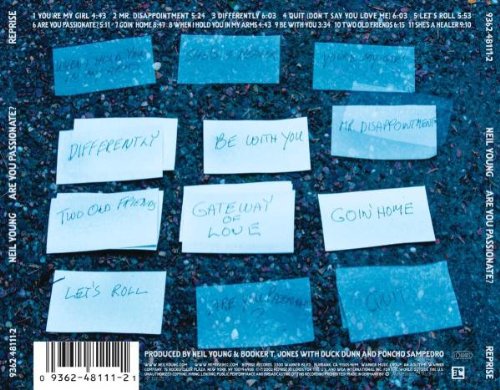
I would also suggest if, I might, trying the entire album in an alternate sequence. The running order of the tracks is the only reservation I have about the album. As I said, the opening track isn't one of the most impressive ones and I can't help but fee the flow isn't always quite there. Neil may, in fact, have been equally ambivalent, as he used the album art to give us this alternate version, in the form of a picture of series of notecards on the rear cover:
1. When I Hold You in My Arms
2. She's a Healer
3. You're My Girl
4. Differently
5. Be With You
6. Mr. Disappointment
7. Two Old Friends
8. Goin' Home
9. Let's Roll
10. Are You Passionate?
11. Quit (Don't Say you Love Me)
To some degree, I wish this sequence had been used. It gives the album a more experimental feel, which fits with this being Neil's first foray into soul and R&B music, though it also makes the album tonally darker at times. The final arrangement seems geared towards making the album as commercially accessible as possible. But considering how it was generally received, that was a bit of waste to be brutally honest. Still, I don't think one version is necessarily "better" than the other. Personally, I might have chosen the one that wasn't used, but It depends what you're in the mood for. So if you're going to try 'Passionate' at all, I would recommend trying both sequences. Obviously you can also try your own, though I've yet to find anything as effective as the versions Neil gives us.
All in all, I won't say this is Neil's lost gem, or a really brilliant album. It is, however, rather underrated and quite interesting, both musically lyrically. In fact, the musical experimention is of such merit that, while I used to consider the songs on
to be stronger material, this album is increasingly the more interesting of the two, and has certainly become the one I return to more often.
In addition I wouldn't recommend AYP? as a place to start, nor are more casual fans likely to appreciate it as much as the thoroughly devoted. I would, however, encourage anyone interested in either Neil or Booker T. to give it a fair chance at some point, in spite of the lukewarm publicity surrounding it. It's actually one of his more interesting recent albums and if I were you, I wouldn't want to miss it. Sure, it's different--it's an experiment. That's part of the fun.
'Are You Passionate?' is a fun, yet multi-faceted and fascinating, album full of vigorous, joyful musical experimentation and excellent, highly relatable, spiritually searching, thought-provoking lyrics on a wide scope of topics, highly recommended for established fans of the artists involved. Let the good times roll.
DIK
Four decades and 36 albums into his career, Neil Young continues to explore his versatility with Are You Passionate. While his collaboration with Booker T & The MGs may seem discrepant, the loose guitars of Young and Crazy Horse sidekick, Frank "Poncho" Sampedro, frequently bridge the gap between grunge and soul. The results are often marvelous.
Past departures from Young's folk and rock roots, such as Time Fades Away, Trans, Everybody's Rockin' or Landing on Water, were either flat or baffling or just plain awful. However, a sense of purpose and, yes, passion, makes this the most compelling experiment of Neil Young's erratic career. Something genuinely fresh derives from many of these songs, in which Donald "Duck" Dunn's bass and the sly croon of Booker T. Jones' trusty organ sweetly complement Young's familiar guitar licks.
"I knew that I wanted to play my guitar more like a saxophone this time," Young told Pulse magazine, "And I felt more like a horn player while I was playing my guitar." But while Young & Co. manipulate familiar instruments to create fresh sounds, the addition of bongos, tambourines, vibes and the occasional, hauntingly distant burst of a trumpet makes this one of Young's most flavorful projects.
With the exception of "Let's Roll" -- an embarrassing nod to the abundance of 9-11 tribute songs -- many tracks on Are You Passionate? demonstrate the kind of lyrical honesty that is unique to Young's best songwriting, revisiting themes of love, hate and loss with renewed inspiration. Whereas Young's previous album, Silver & Gold, was both musically and lyrically lackadaisical, these new songs are focused, inspired and occasionally biting. "Please don't tell me that you're leaving me just yet/'Cause I know I gotta let you go/Please don't tell me that you're saying goodbye," Young sings on "You're My Girl," a farewell song to his college-bound daughter, Amber. Other songs, such as "Two Old Friends," suggest that Young's days of innocence, love and politics have acquiesced to the world-weariness and nostalgia of middle-age:
"The Preacher went up to the Golden Gate and met God there
No my son. That time is gone.
As though to accommodate the album's bluesy ambiance, other songs bravely walk through memories of lost love and desperation, as on the beautifully tender "Mr. Disappointment": "I'd like to shake your hand, Disappointment / Looks like you win again, but this time might be the last."
Elsewhere, Young reveals himself in intimately confessional statements such as the album's final words: "All I got is a broken heart and I don't try to hide it/When I play my guitar."
While these mellow, sweet and introspective tunes foreshadow twilight ahead for the godfather of grunge, there are still some raucous reminders of younger, angrier days. If it really is "better to burn out than to fade away," then tracks like "Going Home" and "Differently" suggest that Young is taking his own advice. Ralph Molina's outraged drums punch through "Going Home" with ceaseless ferocity, while Young and "Poncho's" berserk guitars sing their decades-old anthem to rock and roll as though it were written just yesterday.
At 56 years old, Neil Young insists that he still has something to prove. Not only is this one of 2002's most inventive and inspired albums, it disputes the unfortunate stereotypes that dog rock's aging stars. "People my age, they don't do the things I do/They go somewhere while I run away with you," Young sings on Mirror Ball's "I'm The Ocean." Are You Passionate? reveals that the man means what he says.
Are you passionate is Neil's new jewel, mellow, uplifting and, at the same time, profound! Mr disappointment is an instant classic. On 'Going Home' Neil is backed up by Crazy horse, fabulous!
However, most surprising to me was this record's very intense sound mixed with Neil's 'new' guitar style, subtle and groovy at the same time.
It is this intensity that certainly makes up for one of the 'weaker' tracks like 'let's roll', which just seems a little out of place on this 'liuttle' masterpiece.