


Maria Callas Album: «Bellini: Norma (complete opera live 1952) with Maria Callas, Mirto Picchi, Vittorio Gui, Orchestra & Chorus of the Royal Opera House, Covent Garden»
Maria Callas Album: «Bellini: Norma (complete opera live 1952) with Maria Callas, Mirto Picchi, Vittorio Gui, Orchestra & Chorus of the Royal Opera House, Covent Garden»
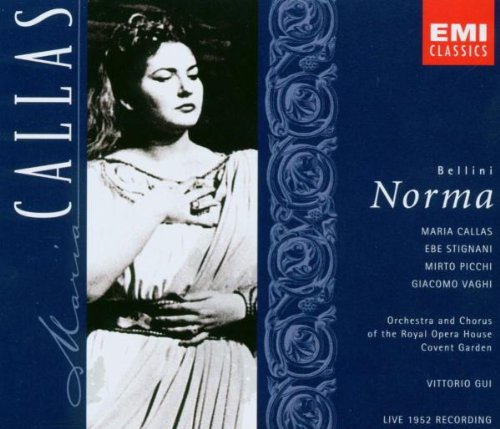
Maria Callas Album: «Bellini: Norma (complete opera live 1952) with Maria Callas, Mirto Picchi, Vittorio Gui, Orchestra & Chorus of the Royal Opera House, Covent Garden»
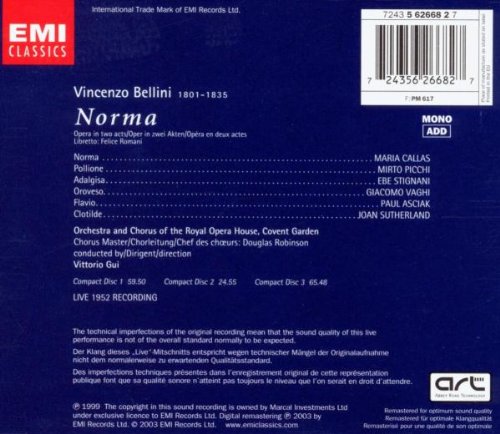
- Customers rating: (4.4 of 5)
- Title:Bellini: Norma (complete opera live 1952) with Maria Callas, Mirto Picchi, Vittorio Gui, Orchestra & Chorus of the Royal Opera House, Covent Garden
- Release date:2003-11-04
- Type:Audio CD
- Label:EMI Classics
- UPC:724356266827
- Average (4.4 of 5)(18 votes)
- .14 votes
- .1 vote
- .1 vote
- .0 votes
- .2 votes
- 1 - 1Sinfonia
- 1 - 2Ite Sul Colle Dell'aura Tua Profetica
- 1 - 3Svanir Le Voci!
- 1 - 4Meco All'altar Di Venere
- 1 - 5Odi?...I Suoi Riti A Compiere
- 1 - 6Me Protegge, Me Difende
- 1 - 7Norma Viene
- 1 - 8Sediziose Voci
- 1 - 9 Casta Divaimg 9:25
- 1 - 10Fine Al Rito, E Il Sacro Bosco
- 1 - 11Ah! Bello A Me Ritorna
- 1 - 12Sgombra E La Sacra Selva
- 1 - 13Eccola - Va, Mi Lascia
- 1 - 14Va, Crudele
- 1 - 15Vieni In Roma
- 2 - 1Vanne, E Li Cela Entrambi
- 2 - 2Adalgisa!...Alma, Costanza
- 2 - 3Oh, Rimembranza!
- 2 - 4Ah Si, Fa Core, Abbracciami
- 2 - 5Ma Di'...L'amato Giovine
- 2 - 6Oh, Di Qual Sei Tu Vittima
- 2 - 7Perfido!...Or Basti!
- 2 - 8Vanne, Si, Mi Lascia, Indegno
- 3 - 1Introduzione
- 3 - 2Dormono Entrambi!
- 3 - 3Ola! Clotilde!
- 3 - 4Mi Chiami, O Norma?
- 3 - 5Deh! Con Te, Con Te Li Prendi
- 3 - 6 Mira, O Normaimg 4:26
- 3 - 7Cedi...Deh Cedi!
- 3 - 8Si, Fino All'ore Estreme
- 3 - 9Non Parti?
- 3 - 10Guerrieri! A Voi Venirne
- 3 - 11Ah! Del Tebro Al Giogo Indegno
- 3 - 12Ei Tornera. Si!
- 3 - 13Squilla Il Bronzo Del Dio!
- 3 - 14Guerra! Guerra!
- 3 - 15Ne Compi Il Rito, O Norma?
- 3 - 16In Mia Man Alfin Tu Sei
- 3 - 17Gia Mi Pasco Ne' Tuoi Sguardi
- 3 - 18Dammi Quel Ferro
- 3 - 19Qual Cor Tradisti
- 3 - 20Norma! Deh! Norma, Scolpati!
- 3 - 21Deh! Non Volerli Vittime
It's nice that EMI has given this 1952 performance a legitimate presentation. At the time of this live performance,
Callas was not yet thirty, vocally spectacular, and on the verge of the most spectacular operatic career of the century. The Callas heard here is the heavy-set woman of the early 1950's, with a full dramatic soprano capable of negotiating the most intricate coloratura. Her Norma at this point had yet to acquire the subtle nuances of later (and less vocally reliable) years, but there is no question of the complete security of her voice. She is partnered here by the veteran mezzo Ebe Stignani, who to my ears sounds aged and matronly for the youthful role of Adalgiza (how she managed to sound so much better three years later in the RAI performance, also with Callas, is something I will always wonder about). The tenor is adequate - certainly not in the Del Monaco-Corelli class. The sound, surprisingly enough, is pretty listenable. Make no mistake, I am giving this recording five stars for Callas, and for many, that will be more than enough reason to purchase, listen, and to value this recording.
I think this is a great live-recording, esp. the duet "Mira o Norma" and the final scene are very beautiful. I like it more than Callas'studio-Normas... I'd recommend it!
I've done a project which consisted interviewing opera-experts in 13 countries, it contained the question "Which Norma springs to mind immediately?" Of over 150 people asked 134 said "CALLAS!", 8 said "PONSELLE!" five said "SUTHERLAND!" and three said "MILANOV!". When asked for further explainations it was said that Callas put a stamp on this role that will never vanish. Edita Gruberova mentioned her nervousness when it comes to tackling Norma because this role "belongs" to Callas. Caballe voiced similar fear and worked with Callas on the role. (Caballe said that Callas was the sweetest, most precious advisor she ever had) Callas then gave Caballe the earrings she had worn during her greatest performance of Norma, the La Scala opening in 1955. (A live-recording is available) Here we can hear how right such titans as Caballe and Gruberova are. Callas owns the role of Norma. Critics, colleagues and a faithful audience (It's now 30 years ago that Callas sang her last Norma) prove it. This Norma is essential. In Gui this set has one of the greatest Bellinian conductors, much better than Muti, Levine or Bonygne who also conducted Norma-recordings.
~Estelle
If you think the 1955 Scala Norma with del Monaco and Simionato was legendary, wait until you hear this! This is Norma like it has never been sung before! At 1952, Callas was still the heavyset woman that she was during the earlier part of her career. And during this time, her voice was still a large, brilliant column of sound that could easily overpower the orchestra and her fellow singers without difficulty. And what is truly amazing is this performance with Vittorio Gui (later to conduct her legendary La Scala Traviata) in the pit, a better-sounding Ebi Stignani, and an amazing tenor with the name of Mirto Picchi. Callas was the legendary dramatic coloratura d'agilita that most people fantasized her to be during this night, and none of her notes resembled the voice which would soon arouse controversy amongst her many detractors years later. Her interpretation was as always, the greatest, and since the power of her voice had not yet diminished, her fury duets beginning with "Ma di l'amato giovane...Oh non tremare" to "Oh di qual sei tu vittima" and "Perfido...Vanne,si,mi lascia indegno" are simply mind blowing. Her first recitatives, aria, and cavatinas are sung with seamless legato, and the final scene is as what most Italians would call (in reference to operatic perfection), Pace Verdi. And oh, did I mention Joan Sutherland's brief appearance as Clotilde in this performance? Too bad they didn't cast her as Adalgisa, otherwise this would be the greatest Norma of recording history! I just wish Dame Joan would have learned more about drama from Callas, otherwise her Norma would have been truly the greatest after La Divina. But no complaints about her Adalgisa, as Stignani sounded fresh and dramatically convincing as Adalgisa in this record. Mirto Picchi may not have the instant heroic timbre of Corelli and del Monaco, but he proved to be Callas' dramatic equal in that night's performance...a fine Pollione as I would say. Listen to the last act, and you would understand why Callas' Norma will always hold supreme over other Normas, even Ponselle, who was famous for triumphing in that role only half a century earlier.
I'm thankful to EMI for releasing this definite performance of NORMA in such brilliant sound. Were it not for the applause it could be a studio-recording. Absolutely beautiful, the very best Norma!!!