


Disco de Kitaro: «Ki»
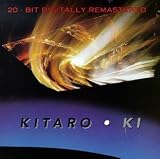
Disco de Kitaro: «Ki»

- Valoración de usuarios: (4.9 de 5)
- Título:Ki
- Fecha de publicación:1996-11-05
- Tipo:Audio CD
- Sello discográfico:Domo Records
- UPC:794017105727
- Media (4.9 de 5)(10 votos)
- .9 votos
- .1 voto
- .0 votos
- .0 votos
- .0 votos
- 1 Revelationimg 7:02
- 2Stream of Being
- 3 Kaleidoscopeimg 4:37
- 4 Oasisimg 4:33
- 5Sun
- 6Endless Water
- 7Tree
- 8Cloud In The Sky
In 1985, I walked into a bookstore in Lewiston, Maine, and thought I was hearing music from the heavenly spheres. They were playing "Ki", and I became a Kitaro fan from that day on.
Of all my many Kitaro CDs, "Ki" is still my favorite...the one I have 2 copies of, as it's one of the 8 CDs I keep in the car.
I'm one of those that tend to prefer the "pre-U.S.A." Kitaro. Of his recordings, and sadly many are out of print at this time, "Oasis" (track # 4 on "Ki" is same glorious track # 10 theme of the "Oasis" CD), "Asia", "Full Moon Story", and "Silk Road Vol. 1" fill out the top 5 choices for me, and "Ki" of all of them succeeds the best in being a continuous flow of exquisite, soul-filling melody.
The enclosed leaflet says that on this recording Kitaro plays Korg, Roland, Yamaha, Prophet and Mini Moog synthesizers, acoustic guitar, slide guitar, mellotron, drums, percussion, tabla, and Irish harp. The remastered sound is good, and total time 44'12.
I have most of kitaros music, and this is the one I use the most. It can put me in my own little world.
Well, not exactly. Strangely I got Nipponjin (1975) and Parallel World (1976), two albums from a prog rock band he was in called Far East Family Band, dating back when he was going by his real name, Masanori Takahashi, before I went and got any of his solo albums. Those Far East Family Band albums bear little resemblance to what he would pursue on his own (except maybe a couple passages on Parallel World), having more in common with the likes of Pink Floyd, or (especially on Parallel World) Klaus Schulze or Tangerine Dream (Schulze actually produced both Nipponjin and Parallel World). It's very much like the difference between Vangelis with Aphrodite's Child and his own solo efforts (although Vangelis did release a couple of solo albums that do resemble Aphrodite's Child).
Kitaro's discography is awfully confusing, because prior to 1985, none of his albums received an American release. Many titles had Japanese names and later versions had English names (like Ten Kai became Astral Voyage). Ki was released after the three Silk Road series of albums (soundtracks to a Japanese TV documentary), originally released in 1981 on Canyon Records, perhaps the better known version was the German version of Kuckuck, from 1982.
Usually I don't go for New Age music, but this is actually quite good for what it is. Mellow, spacy electronic music, I am really surprised to see Kitaro was still using Mellotron as late as 1981, when groups like Tangerine Dream had already gotten rid of theirs before the end of the '70s. The Minimoog is quite dominant, while also including newer polyphonic synths like the Prophet 5. A lot of this music makes me think of a Japanese garden complete with cherry blossoms and stone lanterns, but then that's no surprise given Kitaro himself is Japanese. Most of this tends to the mellow end of electronic music, while the last two cuts bear more than a passing resemblance to Pink Floyd (because of the use of drums and guitars). It's also interesting to note that his old prog rock band, Far East Family Band had been frequently compared to Pink Floyd.
Perhaps the thing that most bothers me about this album is why did he include two songs from his 1979 album Oasis? On this album he included the title track and "Eternal Spring" (renamed "Endless Water" here), and these don't appear to be re-recordings either, perhaps he didn't have enough new material so he included some earlier stuff too, probably to drive home a point that he hadn't changed much stylistically in the course of two years and three albums (the three Silk Road albums that came between Oasis and Ki).
I have since acquired several of his albums, all early ones, and though I seem to prefer albums like Oasis or In Person, this is still recommended if you like this kind of music.
This cd is awsum, it speaks to you, it will give you goose bumps, it's really great
Not Kitaro's first album, but my first Kitaro album. Since first receiving this as a gift a friend brought from Japan, I have been collecting most of the albums on CD, and some on vinyl (ncluding Ki, just acquired, and it sounds fantastic on vinyl!). Many of the other albums are superb (India, Silk Road, etc), but this one remains the favorite. Every piece is perfect, the flow is beautiful, and the climax when rhythm appears in Cloud is majestic. Highest recommendation.