


Joni Mitchell Album: «Turbulent Indigo»
Joni Mitchell Album: «Turbulent Indigo»
- Customers rating: (4.7 of 5)
- Title:Turbulent Indigo
- Release date:1994-10-25
- Type:Audio CD
- Label:Warner Bros / Wea
- UPC:093624578628
- Average (4.7 of 5)(34 votes)
- .28 votes
- .4 votes
- .1 vote
- .1 vote
- .0 votes
- 1 Sunny Sundayimg 3:02
- 2 Sex Killsimg 4:06
- 3How Do You Stop
- 4Turbulent Indigo
- 5Last Chance Lost
- 6The Magdalen Laundries
- 7Not To Blame
- 8Borderline
- 9Yvette In English
- 10 The Sire Of Sorrow (Job's Sad Song)img 7:07
This was the first Joni Mitchell cd I bought, and is it ever an eye-opener. Her voice is so deep and so rich, you'd think she was related to Sarah Vaughn or Anita Baker, and the music never distracts from her voice. Her choice of topics here is certainly serious, with song titles like Sex Kills and Turbulent Indigo. And her disdain and utter shock at people's immoralities show on Not To Blame, Magdalene Laundries, and Borderline. But my two favorites are those that end the disc, Yvette In English and Sire of Sorrow. Yvette is almost light and breezy, while Sire of Sorrow evokes memories of Coyote from Hejira. This release certainly was deserving of its Grammy Award.
Joni Mitchell makes her comeback complete, after the beautiful Night Ride Home. This collection of songs equal the best of her earlier work. She talks about a lot of subjects, from the oppression of women on The Magdalene Laundries (about Irish nuns in a convent) and Not To Blame (about women who are abused.)
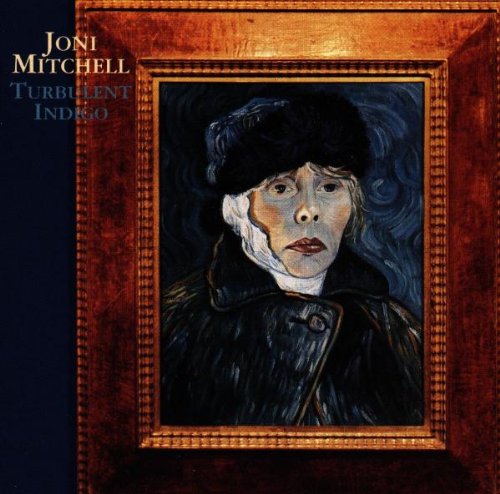
The way the people see artists and vice versa is the subject of the title track, with references to Vincent van Gogh (who she imitates on the album sleeve. Another highlight are the complex guitar tunings from Joni. This album has won two grammys in 1996, one for best pop album, winning over Madonna, Mariah Carey and Annie Lennox. The second was another deserved one, for the recording package. The paintings in the sleeve are incredible beautiful and burst with colours and shapes. Turbulent Indigo is one of my favourite albums and stands in the top three of my most beloved albums from Joni Mitchell!
Blazing intelligence and talent that will light our culture long after Britney Spears is running a souvenir shop in Las Vegas.
for when you really need to cry
As a Boomer who came of age during the halcyon days of the Sixties, I fondly recall the burst of creativity in music and the arts that those years brought forth. I acquired an enviable collection of vinyl LP's, and through repeated listening saturated myself with their inventiveness along with every nuanced detail.
Fast forward to the present time - for decades now I've been listening primarily only to symphonic music or other instrumental pieces, or exotic songs sung in foreign languages, so as to avoid the distraction of trite lyrics (not to mention some less than appealing musical styles). As such, I've been out of the 'pop culture' loop for many years.
But as fate would have it, a copy of "Turbulent Indigo" has just recently landed in my lap. This has amounted to a reawakening for me. I much enjoyed "Hejira" and some of Joni Mitchell's other recordings years ago, but then lost track of her. Then I heard her perform "Sex Kills" on a TV documentary (an eye and ear opener), and I followed the trail to "Turbulent Indigo". When I first heard it, I was unsure what to make of it. Being "lazy", I left the CD in place and subsequently listened to it over again. And again. I'm struck and enriched by something different each time. Lightbulbs are going off everywhere. Joni Mitchell is a poet of the first degree and a true artist, and I'm delighted to find out that I'm still capable of being passionate about something. Joni puts the muse back in music; otherwise it's just 'ic', as she'll tell you.
"Turbulent Indigo" has given me an education ("The Magdalene Laundries") along with its invocation of the literature and art of others ("Sunny Sunday" "Yvette in English" "Turbulent Indigo"), and even the Old Testament ("The Sire of Sorrow"). And only after listening to it many times did I learn that "Turbulent Indigo" won multiple awards. Wow; is it ever worthy. For once the music industry got it right.