


Chicago Album: «Chicago V»
Chicago Album: «Chicago V»
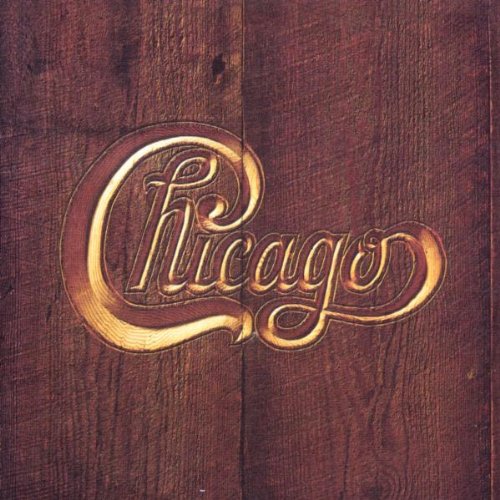
Chicago Album: «Chicago V»
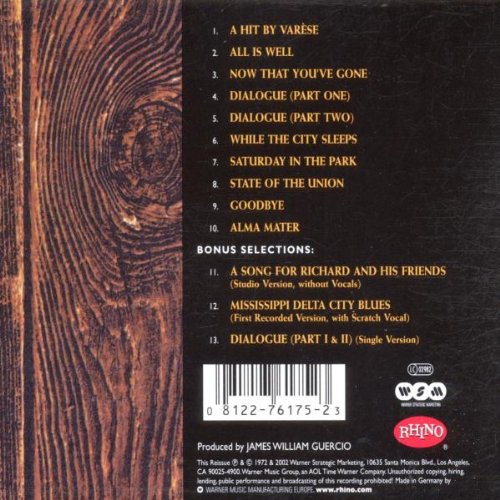
- Customers rating: (4.5 of 5)
- Title:Chicago V
- Release date:2002-08-20
- Type:Audio CD
- Label:Rhino
- UPC:766483324964
- 1A Hit by Varèseimg
- 2 All Is Wellimg 3:31
- 3 Now That You've Goneimg 4:53
- 4Dialogue (Part One)
- 5Dialogue (Part Two)
- 6While the City Sleeps
- 7Saturday in the Parkimg
- 8Sate Of The Union
- 9Goodbye
- 10Alma Materimg
- 11A Song for Richard and His Friends
- 12Mississippi Delta City Bluesimg
- 13Dialogue (Part I & II) (Single Version)
Given the transitional nature of Chicago V, I can't imagine that all diehard fans of the more poppy Chicago material and all diehard fans of the first three recordings would like it, although there must be some overlap. As a huge fan of the first three recordings (and as a bassist), I feel that Chicago V (1972) along with their 1969 debut (Chicago Transit Authority), II, III, and the live recording IV, defines a period where the band was at a creative peak. Although there are the (so-called) "pop" hits "Saturday in the Park", "Dialogue Pts I and II", and I suppose to some extent "All is Well", Chicago V is far from being a pop vehicle. Instead, the music seamlessly bridges the gap between their smash hits and the wild, full-throttle acid jazz-rock of 69-71. Specifically, the "big band" type arrangements on V (nearly all of which were written by Robert Lamm) sacrifice none of the instrumental virtuosity or experimentation of earlier works, although the pieces are somewhat shorter and presented in a tighter, more cohesive format. For example, there are no lengthy song-cycle suites or extended guitar solos. It does not however, take a careful listener to appreciate the sheer complexity of the arrangements on V, which emphasize dense ensemble work, odd time signatures (the waltzy 3/4 and 6/8 are used quite a lot, amongst others), and unusual chord voicings, in addition to the wide stylistic range of the music, which runs the gamut from the gospel-ish vocal parts on Alma Mater, to the awesome jazz-rock of "State of the Union" and "Goodbye". All of the musicians are absolutely top shelf and Peter Cetera is unquestionably the most under-rated bass player in all of rock. In fact, he is one of the few rock bassists that can play a convincing walking bass line. All in all, this recording (including the bonus tracks) makes a nice bookend at the conclusion of a five-album sequence of incredible music written during 1969-1972 that is also indicative of future trends. As a fan of both jazz-rock and progressive rock, Chicago V works for me on a number of levels and is highly recommended along with CTA, II, III, and IV.
Chicago V, released in 1972, remained the band's most successful album until Chicago 17, when that recording, with it's barrage of power pop hits went on to become their biggets seller after it's release in 1984. The success of Chicago V can be attributed, in large part, to the strength of the hit single "Saturday in the Park". This is truly a signature Chicago pop composition in every sense with Robert Lamm belting out the lead vocal with his warm timbre, the Chicago horns playing in classic style and great harmony vocal and rhythym section arrangements. This song stands as one of the all-time great pop music recordings and still sounds fresh today coming over the radio due to it's incomparable melody, timeless style and lean n' clean production value.
Unfortunately, because of the magnitude of the popularity of "Saturday in the Park", Chicago V is sometimes referred to as the point where Chicago tuned "pop", "soft" or "sold out".
Fortuntely, none of this is true. This album finds the legendary band presenting some of their most focused writing and most avante-garde approach to the compositions and arrangements as found on any Chicago release.
In the summer of 1972, I had just finished 6th grade. Everywhere you went that summer, every party, every event, you could hear this album playing. My brother, who had just gotten his driver's license, had the 8-track of it, and played it non-stop. It was part of the soundtrack of the summer of '72, that short "feel-good" interlude between the anger of the 60s and Watergate. Counter-culture was going mainstream, gaining acceptance, and Chicago was at their craft writing the music.
It was when stoners and "bandzies" all loved Chicago at the same time, not to mention critics and the record-buying public.
Everything good about Chicago comes together on this album. Only they could protest while making us smile.
When "A Hit By Varese" opens with a Terry Kath Free Form into, you are about to hear The Original Seven at their creative and professional peak. Another reviewer said it best - this is hard, driving rock-jazz with a vengeance.
This timeless album deserves to be in every music-lover's collection. I love the Rhino reissue with extensive notes and bonus tracks.
I give it a 5-star because there are no 6-stars. There is not a better album by anybody, anywhere.
When Chicago V was released in 1972, the US was still at war in Vietnam, and Richard Nixon was nearing the end of his successful first term as president. But fatigue was gripping the nation and the band as well, which had been in the pop-musical spotlight for the better part of four years. Some of that fatigue is apparent on this, the first one-album release since the band's formation.
Listening to this album now is a different experience that it was when I was a high school sophomore. Then, I was more excited by the band's big hits like "All is Well" and "Saturday in the Park" (whose opening piano chords even I could play!) but less excited by jazz and experimental music. Now, I can measure the change in my musical tastes by my appreciation of the cuts that did not become hits. "A Hit by Varese" is (mostly) a classic piece of energetically-syncopated brilliance. "While the City Sleeps" has a phenomenal show of triple-tonguing brass technique and neatly expresses the 70s paranoia that "men are scheming new ways to kill us and tell us dirty lies." But something new has crept into the lyrics of several songs -- the disappointment that many Americans are still compacent about issues the band cares about. The disparity of reactions is expertly rendered in "Dialogue" in which Terry Kath and Peter Cetera play two faces of the American political divide. Kath, as the activist and anti-war voice, tries to goad Cetera into expressing upset over the continuing war and poverty. Cetera plays the happy college grad student oblivious to social ills, who only "hopes to study further...and...keep a steady high," presumably with illicit drugs. That Cetera wins over Kath (and that the song is seemingly shut off mid-riff) has the intended unsettling effect.
"Chicago V" has serious flaws, even in its hits. "All is Well" is a sweetly-harmonized and doleful look back at the painful end of a love affair. But the horn solo that Jim Pankow inserts into this graceful tune is mechanical and inappropriately edgy. And it doesn't take a PhD in musical theory to hear the opening bars of "Saturday in the Park" as flatfooted and unsophisticated. That the producer spared the red pencil on the badly-performed ad lib horn solos in the middle of "A Hit by Varese" is emblematic of the album's problems.
Anyway, enough griping. Even longtime Chicago fans like me who have outgrown their youthful infatuation with the band will find gems here. The brass solo in "Now That You've Gone" is as bright and breezy as any of the band's best. "Dialogue," heard in the context of a foreign war waged by an unpopular president, (sadly) resonates today with the same wicked insights as it did 35 years ago -- undoubtedly the reason Chicago still plays it in concert. "State of the Union" and "Goodbye" are solidly-constructed and listenable in spite of not being hit material.
Suggestion: don't buy the CD for the bonus tracks alone! "Song for Richard and his Friends" is an expressionistic anti-Nixon piece that attempts to satirize the administration's pomposity and overreach with extended improvised feedback guitar. Listen to "Free Form Guitar" on the band's first album for a better example of Terry Kath's guitar genius. "Mississippi Delta Blues" is evidently a first attempt at the piece, but Kath's tentative stabs at shaping the tune's melodies sound nothing like the wonderful result that eventually landed on the band's 11th album. And only the most devoted fan wants to hear any of the band's hits (the marvelous "Dialogue," in this instance) diced and sliced to fit the procrustean bed of AM radio's infamous 3-minute slot.
Nevertheless, "Chicago V" has terrific music that can be admired by fan and non-fan alike. Like them or not, Chicago was a terrific band whose combined talents occasionally crossed the line into musical sublimity. And for that, I am grateful and a still a fan.
I have been a long time Chicago fan. (Since the mid 70's)
A lot has already been said about this album already and, if you but this CD, more in the liner notes. Here is my input. Listen to the bass line in this album and you can tell you are listening to true musicians. When you listen to "Goodbye" you realize that Peter Cetera's talent goes beyond the high voiced pop singer. Peter is also the bass player and the bass lines here are very intricate. In my opinion this is the one Chicago album that appeals to the more serious musician. Even though it includes "Saturday in the Park" one of their biggest top 40 hits.