


Peggy Lee Album: «Trav'Lin Light»
Peggy Lee Album: «Trav'Lin Light»
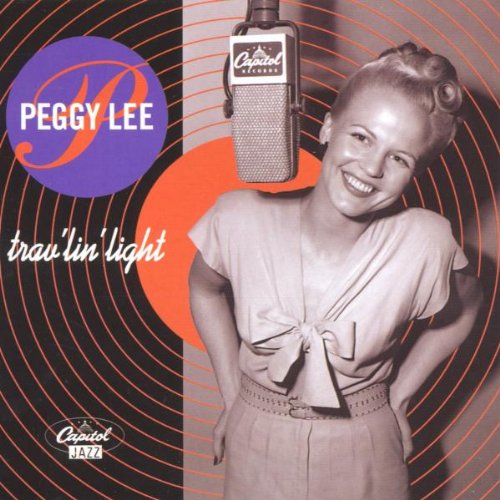
Peggy Lee Album: «Trav'Lin Light»
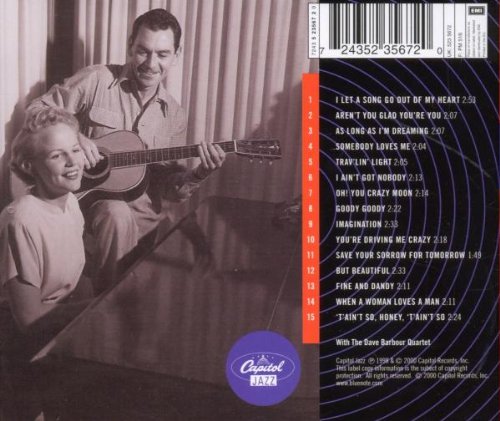
- Customers rating: (4.5 of 5)
- Title:Trav'Lin Light
- Release date:2000-02-29
- Type:Audio CD
- Label:Capitol
- UPC:724352356720
- Average (4.5 of 5)(10 votes)
- .8 votes
- .1 vote
- .0 votes
- .0 votes
- .1 vote
- 1I Let a Song Go Out of My Heart
- 2Aren't You Glad You're You
- 3As Long as I'm Dreaming
- 4 Somebody Loves Meimg 2:59
- 5Trav'lin' Light
- 6I Ain't Go Nobody
- 7Oh! You Crazy Moon
- 8 Goody Goodyimg 2:25
- 9Imagination
- 10You're Driving Me Crazy
- 11Save Your Sorrow For Tomorrow
- 12But Beautiful
- 13 Fine and Dandyimg 2:13
- 14When A Woman Loves A Man
- 15'Tain't So, Honey, 'Tain't So
Though not as early as her Benny Goodman sessions these were mainly from radio transcriptions, previosly avaialble through import labels. This is the first time they have been available domesticly though capital. Highly enjoyable and mamture Peggy Lee recordings accompanied by a good jazz combo led by her then husband David Darbour. Good music good jazz influenced singing, and aside from Anita O'Day, Miss Peggy Lee was the blackest white singer there ever was. Strongly recommeded.
it really is a shame that all the material from these transcriptions is not readily and affordably available as this is an utterly superlative set of tunes . Lee's voice is truly amazing on these songs , maybe as a result of not having to push to be heard over the larger ensembles she was used to working with . the warmth and sweetness of her singing here is just ineffable .
" goody goody " in particular just drives me nuts ! the way she
says " you ol' rascal you " at the end is just sublime .
Like Sam Cooke's "Night Beat," this disc is a revelation for those used to hearing a particular singer in a big-combo setting. Here it's just Lee with a quartet. I never realized what a tremendous singer she was until I found this disc. Husband Dave Barbour throws in tons of tasty guitar licks.
This is not the first time these transcriptions have been released - these were all on the Mosaic boxset of complete Capitol transcriptions of Peggy Lee and June Christy. On this rather chintzy selection of tracks, the remastering engineer turned the "noise reduction" to eleven. These recordings sound clear and full on the Mosaic set; here they sound like a wet blanket was draped over the speakers. The best thing about this CD is the cover (which was also borrowed from the cover image of the Mosaic set).
This may be the best collection of Peggy Lee performances I've come across yet, and I've heard several hundred Lee perforamces, from the early 1940s extending into the 1990s, including the Decca album, "Black Coffee," most frequently singled out as her best jazz outing. But the present session finds Peggy at the precious instant just before she was transformed from fresh and wholesome, big band canary for Benny Goodman, still revealing some of the wide-eyed excitement of Norma Delores Eggstrom just after realizing her girl-hood dreams of becoming a bona fide "star" and the time of her chic celebrity, when she was "the" American diva and musical icon with the carefully coifed and smartly designed wardrobe along with a confident and relatively permanent persona renowned as much for its scarce and high price tags (to those of us who tried to catch her live) as for her extraordinary musicianship. In short, there's just as much of Norma on this collection as Peggy.
This is how Billie Holiday would have sounded if her life had not been weighed down with all the baggage--the heroin, the discrimination, the exploitive men. Even the photos of Peggy in the booklet accompanying the album can't conceal the innocent Midwestern natural beauty, and the musical accompaniment is all that she requires--or that any listener could ask for. Not the orchestral arrangements that can sounded dated from one decade to the next, but just a rhythm section with her first love, Dave Barbour, on guitar. As for the repertoire, no concessions to the hit parade. It's all grade A, Great American Songbook material, with definitive interpretations by Peggy on each.
As usual, Peggy brings each tune in at closer to 2 than 3 or even 2 and one-half minutes. Unlike so many of the CD offerings these days, on which tracks are "stretched" with gratuitous solos just to fill the 80 minutes, each tune is reduced to its melodic, harmonic, lyric essence (who would want to "pad" a Shakespearean sonnet for the sake of filling time?). Fifteen songs in a Lee program don't come to much more than 30 minutes, but I can't in my wildest imagination picture anyone asking for a refund. Any listener who listens will be served like a king or queen. The closest album to this one, in fact, is Nat's Cole's admired "After Midnight" session from 1956. Though recorded in 1946-47, the fidelity is as up close and personal as the later recordings from the "hi fi" 1950s.
Most of the songs will be familiar--Van Heusen's "Oh! You Crazy Moon"--but some are pleasant discoveries--the same composer's "As Long as I'm Dreaming" as well as "Save Your Sorrow for Tomorrow" and "'Tain't So,, Honey, 'Tain't So." Anyone who wishes to make the case for Peggy Lee as one of a mere handful of greatest all-time interpreters of American popular song had better have this one in their collection.